What Are the Biggest Time Wasters in Hospitality Scheduling?
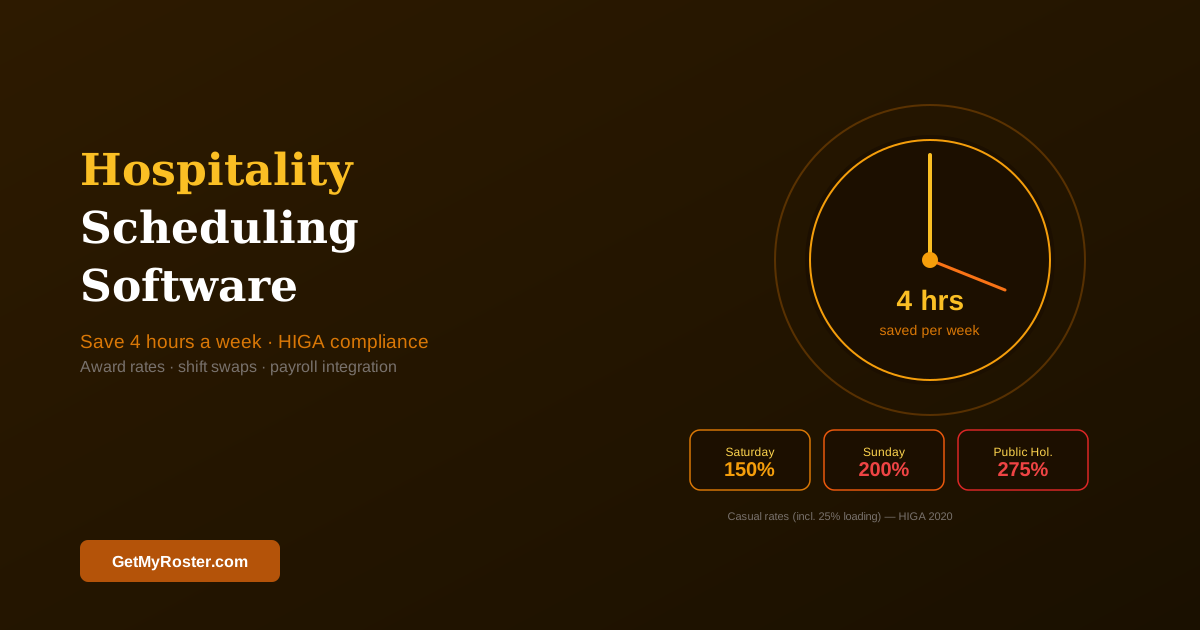
The three biggest time wasters are: rebuilding the same basic roster from scratch each week instead of maintaining a template, managing shift swap and unavailability requests through individual messages rather than a self-service system, and manually transcribing worked hours into payroll instead of using a direct integration. Scheduling software addresses all three — which is why managers who switch typically report saving 3–5 hours per week from the first roster cycle.
Hospitality is one of the most scheduling-intensive industries in Australia. High staff-to-customer ratios, frequent part-time and casual employment, complex penalty rate structures, and peak-and-trough demand patterns make every roster a significant administrative and financial decision. This guide covers how scheduling software addresses the specific problems hospitality managers face.
The Hospitality Scheduling Problem
A hospitality manager running a venue with 25 staff is typically managing 8–12 different availability combinations, 2–3 concurrent requests to swap shifts in any given week, penalty rate calculations across 5–6 different rate categories, and the constant tension between under-coverage (service fails) and over-coverage (labour cost blows out). The manual management of this complexity — in spreadsheets, group chats, and handwritten timesheets — is why most hospitality managers spend their Sunday evenings on the roster rather than preparing for the week ahead.
The Hospitality Industry Award: What Drives Penalty Cost
The Hospitality Industry (General) Award 2020 (HIGA) sets the penalty rate structure for most hospitality employees. For casual employees: Saturday is 150%, Sunday is 175%, public holidays are 250% or higher by classification. Evening rates apply after specified hours (check the current Award). The 2-hour minimum engagement means a short call-in shift requires a 2-hour minimum payment. Understanding the Award is essential to building a cost-effective roster — the difference between a Saturday night and a Sunday lunch in labour cost terms is significant. For the full penalty rate compliance context, see our scheduling law guide.
Self-Service Shift Swaps: The Feature That Saves the Most Time
In a 25-person team, shift swap requests are a constant stream of individual messages. Every swap requires the manager to verify the requestee's availability, confirm they're qualified for the shift, approve the change, and update the record. In a manual system, this is 10–20 minutes per swap. In scheduling software with self-service swap management, the employee initiates the swap, the system checks availability and qualifications, and the manager approves (or auto-approves) with a single notification. The time saving per swap is modest; multiplied across 2–4 swaps per week, it compounds to meaningful hours per fortnight.
Demand-Based Scheduling for Hospitality
The most labour-cost-effective hospitality rosters are built from booking and covers data. A venue that historically fills 30% of capacity on Monday lunch and 95% on Saturday dinner doesn't need the same staffing for both services — but many do, because the roster template hasn't been reviewed against actual trading data. The data-driven approach to this problem is covered in full in our 7 data-driven scheduling steps guide.
Frequently Asked Questions
How much time does scheduling software save hospitality managers?
Typically 3–5 hours per week. Savings come from: roster template reuse (not rebuilding from scratch each week), automatic availability collision detection, self-service shift swap management, and payroll integration that eliminates manual timesheet transcription. The first roster cycle after switching usually demonstrates the saving clearly.
What Award covers hospitality workers in Australia?
Most hospitality workers are covered by the Hospitality Industry (General) Award 2020. This sets minimum rates by classification, 25% casual loading, penalty rates for evenings, Saturdays, Sundays, and public holidays, a 2-hour minimum engagement for casuals, and split shift allowances. Verify current rates at the Fair Work Commission — penalty rates in hospitality are subject to ongoing review.
What is the most important feature for a hospitality scheduling platform?
For most hospitality businesses: mobile access for managers and staff, Award interpretation (automatic penalty rate calculation), and payroll integration (Xero, MYOB, KeyPay). Real-time labour cost visibility — seeing projected weekly wages as shifts are scheduled — is a close second, particularly for businesses managing tight margins.
Can scheduling software integrate with hospitality POS systems?
Some platforms integrate directly with POS systems to import sales and covers data for demand-based staffing suggestions. More commonly, scheduling software integrates with payroll systems to pass clock-in/clock-out data directly through to payroll processing. Check specific integration compatibility before selecting a platform.
Cut Roster Admin from 4 Hours to 45 Minutes
GetMyRoster is built for hospitality — HIGA Award interpretation, real-time labour cost visibility, self-service shift swaps, and direct Xero/MYOB/KeyPay integration included.
Start Free Trial